
Description (podcaster-provided):
Hello! Welcome to the StarXiv, hosted by Dr Michelle Collins and Dr Payel Das. This is a biweekly podcast that delves into the latest astronomy papers & results from the arXiv. Michelle and Payel are astronomers at the University of Surrey. They love research, but struggle to find time to read a lot of papers. They’re hoping this podcast fixes that. The beautiful logo is designed by Izzy Gray, a PhD student currently studying at the University of Surrey.
Themes and summary (AI-generated based on podcaster-provided show and episode descriptions):
➤ arXiv astronomy papers • JWST/ALMA galaxies, cosmic dawn, Little Red Dots • Milky Way/Andromeda archaeology, mergers, globular clusters, stellar chemistry • black holes, dark matter, lenses, FRBs • machine learning methods • exoplanets, solar system, technosignatures
This podcast is a biweekly discussion of recent astronomy and astrophysics papers posted to the arXiv, guided by working researchers who summarize results and place them in context. Across the episodes, the conversation ranges from nearby Solar System topics—such as lunar and Pluto cratering, Mercury’s magnetosphere, interstellar objects, asteroids, and solar flares—to the large-scale Universe, including cosmology surveys, the cosmic web, gravitational lensing (Einstein rings and arcs), and constraints on dark matter models.
A major throughline is galaxy formation and evolution: how galaxies assemble through mergers, how disks, bars, and halos grow, and what observations of the Milky Way and Andromeda reveal about past accretion events and chemical “fingerprints.” The show frequently highlights dwarf galaxies, ultra-diffuse systems, globular clusters, and stellar streams as tracers of early structure formation. High-redshift discoveries—often tied to JWST, HST, ALMA, DESI, Euclid, and ACT—feature prominently, including unusually luminous early galaxies, star formation in the reionization era, and debates around compact “little red dot” sources and their possible physical explanations.
Compact objects are another recurring theme, with discussions of supermassive, intermediate-mass, and primordial black holes, gravitational waves, tidal disruption events, and supernovae. Many episodes also engage with modern analysis techniques, especially machine learning and data-driven methods for classification, inference, and forecasting in both extragalactic and solar/stellar contexts. A lighter but consistent thread is astrobiology and technosignatures, covering searches for extraterrestrial life, biosignature claims, and observational strategies for detecting possible artificial structures.
|
Episodes:
|
 Episode 43 - early dark energy, the fate of Venusian moons, and the power of forbidden lines
2026-Sep-01
30 minutes
|
 Episode 42 - disk clumps, triple systems and an exciting new stream!
2026-Aug-18
31 minutes
|
 Episode 41 - the age of the Universe, AI and literature reviews, and giant companions
2026-Aug-04
32 minutes
|
 Episode 40 - globular clusters, extended disks, high redshift galaxies and aliens!
2026-Jul-22
30 minutes
|
 Episode 39 – data-driven stellar population studies, multi-scale AGN feedback, and solar flare ribbons
2026-Jun-23
38 minutes
|
 Episode 38 - merging galaxies, exploding stars and the beauty of individual galaxies
2026-Jun-08
35 minutes
|
 Episode 37 - Lunar craters, primordial black holes & growing galaxies
2026-May-25
32 minutes
|
 Episode 36 - Dead Earths, magnetic fields and Galactic amnesia
2026-May-11
33 minutes
|
 Episode 35 - More Milky Way mayhem, Fast Radio Bursts, and very cold disks
2026-Apr-28
34 minutes
|
 Episode 34 - The cosmic web, the ancient Milky Way, and planets around small stars
2026-Apr-13
28 minutes
|
 Episode 33 - Bananas, blueberries, planet eating stars and the fate of the Milky Way
2026-Mar-30
32 minutes
|
 Episode 32 - Ancient star clusters and growing black holes
2026-Mar-16
31 minutes
|
 Episode 31 - Near Earth Objects, Little Red Dots, bursty star formation and life around massive stars
2026-Mar-02
32 minutes
|
 Episode 30 - Direct collapse black holes, nuclear stellar discs, and machine learning merger histories
2026-Feb-16
27 minutes
|
 Episode 29 - Exploding stars, carbon stars, and starbursting pseudo little red dots
2026-Jan-26
32 minutes
|
 Episode 28 - Fading stars, digesting planets and dark matter conundrums
2026-Jan-12
33 minutes
|
 Episode 27: Making a Milky Way, searching for dwarfs, and elusive black holes
2025-Dec-22
32 minutes
|
 Episode 26: A tail of tales, little galaxies, and starspots
2025-Dec-08
31 minutes
|
 Episode 25: Extragalactic exoplanets, simulating individual stars, and galaxy mergers as cosmic ray factories
2025-Nov-24
42 minutes
|
 Episode 24 - Strong lenses, Solar Flares and young, high alpha stars
2025-Nov-12
36 minutes
|
 Episode 23 - Failed galaxies, faint galaxies, and the proto-Galaxy
2025-Oct-27
41 minutes
|
 Episode 22 - ORCs, rings, and Galactic histories
2025-Oct-13
37 minutes
|
 Episode 21 - Mercury, chemistry and quasi periodic eruptions
2025-Sep-29
37 minutes
|
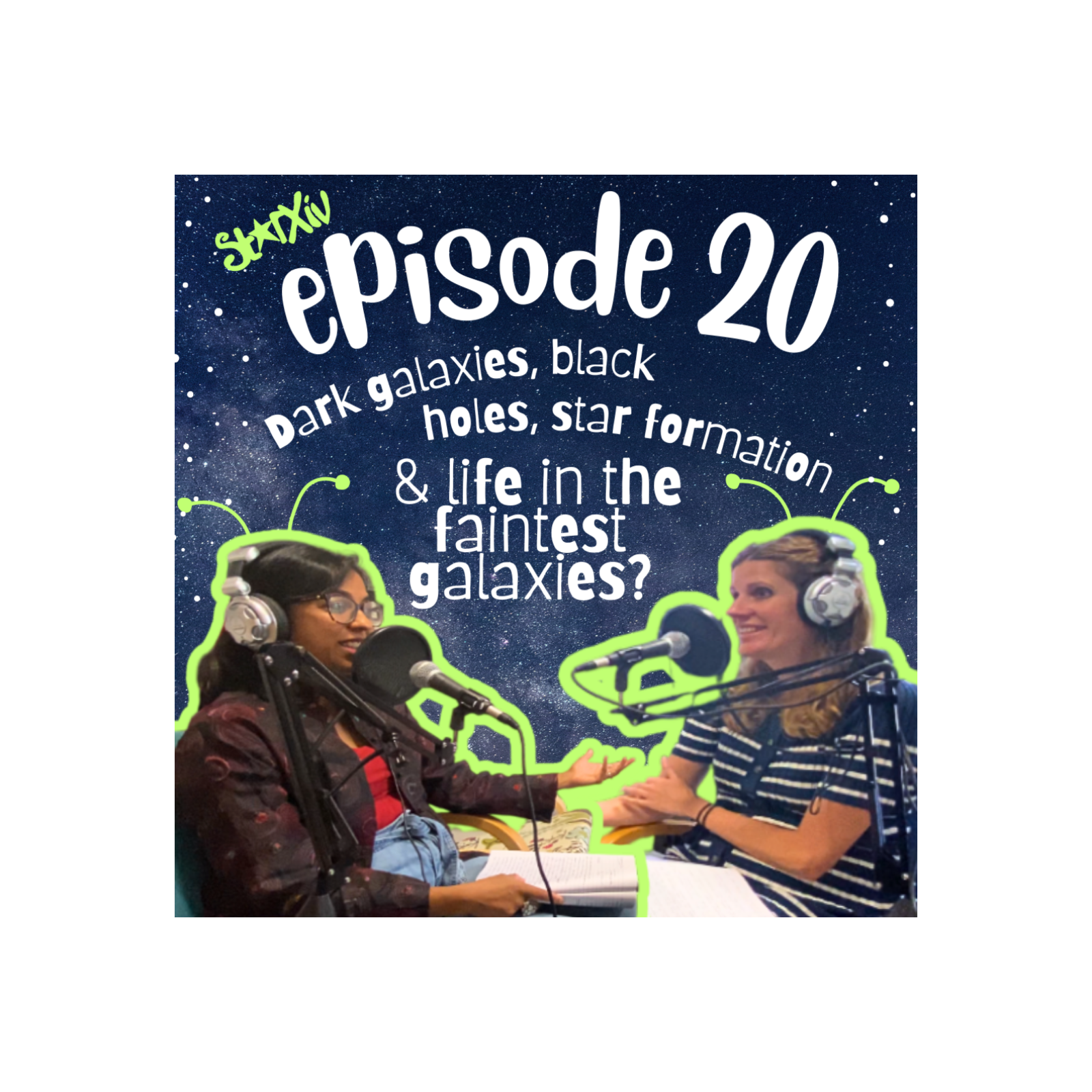 Episode 20 - Dark galaxies, black holes, star formation and life in the faintest galaxies?
2025-Sep-15
33 minutes
|
 Episode 19 - Peering into the Local Universe, distant black holes, forming planets and alien signatures
2025-Sep-01
36 minutes
|
 Episode 18 - disks, disks and more disks!
2025-Aug-18
38 minutes
|
 Episode 17 - detecting dark matter, unusual black holes and speedy stars
2025-Aug-04
38 minutes
|
 Episode 16 - interstellar visitors, molten planets and faint, dark galaxies
2025-Jul-21
35 minutes
|
 Episode 15 – Flare-inducing planets, avoiding catastrophe, and accreted star clusters
2025-Jul-07
39 minutes
|
 Episode 14 - A cosmic owl, misaligned planetary systems, and the Milky Way as an outlier
2025-Jun-23
39 minutes
|
 Episode 13 - Missing Europium, Pluto's craters, 43,000 Goblins and some Pop III stars
2025-Jun-09
34 minutes
|
 Episode 12 - Signs of life, little red dots and the links between star clusters and high redshift galaxies
2025-May-25
39 minutes
|
 Episode 11 - Whirling planes, wandering black holes and alien supernovae
2025-May-12
39 minutes
|
 Episode 10 - Mixing dark matter, surviving black holes and hunting for planets
2025-Apr-28
36 minutes
|
 Episode 9 – Slowing bars, growing black holes, pasta sauces and AI
2025-Apr-14
34 minutes
|
 Episode 8 – Cosmology, pulsars and dark matter in disk galaxies
2025-Mar-31
37 minutes
|
 Episode 7 - Black holes, stealthy satellites and the distance to DF2
2025-Mar-10
30 minutes
|
 Episode 6 - Einstein rings, black holes, and ringed galaxies
2025-Feb-24
32 minutes
|
 Episode 5 - Galaxies, gas accretion, and aliens
2025-Feb-10
32 minutes
|
 Episode 4 - January
2025-Jan-28
28 minutes
|
 Episode 3 - December
2024-Dec-20
46 minutes
|
 Episode 2 - October
2024-Nov-18
35 minutes
|
 Episode 1 - September
2024-Nov-01
27 minutes
|
 Site • RSS • Apple Podcasts